
Piccola statuaria cultuale
Probabilmente l’uso di tenere in casa statue, icone, crocifissi ed altri simboli sacri, si ricollega alla tradizione pagana dei simulacri ad uso familiare, legata comunque ad un rapporto privatistico con la divinità, alla quale si richiedeva protezione per se stessi e la famiglia. Questo uso privato dell’oggetto cultuale ne ha necessariamente determinato la misura, così, dovendo essere collocate in spazi ristretti, le statue non superavano quasi mai l’altezza di cm. 50 (circa). È nostra opinione anche che le caratteristiche iconografiche delle varie statue risentano di questo rapporto privato o intimo, il quale si manifestava attraverso la manipolazione che si operava sulla conocchia, aggiungendo o modificando – se non addirittura rifacendo abiti e accessori – al fine di dare alla statua l’aspetto voluto. In altri termini, noi pensiamo che questi oggetti, anche se non tutti, arrivavano dai luoghi di produzione senza che fosse data loro una attribuzione iconografica specifica, ma che solo successivamente, con opportune modifiche operate sul posto, assumevano le sembianze del Santo secondo la particolare devozione della famiglia o del paese.
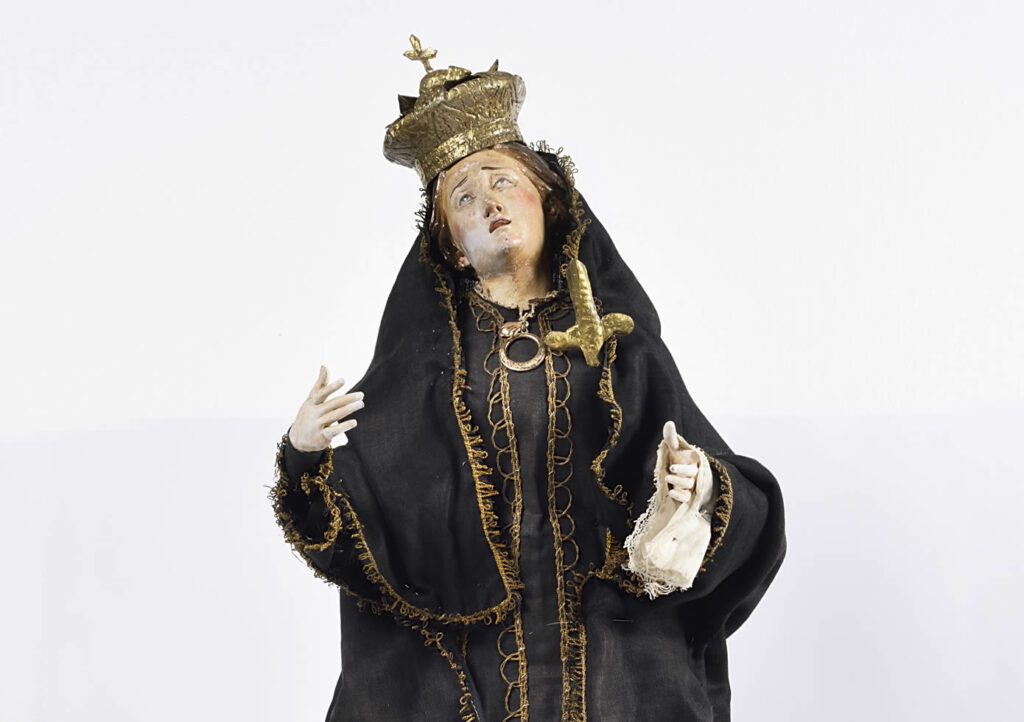
Così a Città Sant’Angelo, dove il culto della Madonna Addolorata è molto diffuso, è frequente la statuina con il classico abito nero con bardature dorate, la corona, il fazzoletto nella mano, il pugnale che le trafigge il cuore; quasi a voler riproporre in «piccolo» (nell’intimità) ciò che il popolo in «grande» nelle occasioni di festività porta in processione, nel consumo collettivo del rito.
Come abbiamo accennato in precedenza gli studi sulla «conocchia» non consentono il raggiungimento di una schedatura scientifica degli oggetti in nostro possesso, soprattutto in merito alla loro datazione ed alla loro attribuzione.
Le poche notizie le abbiamo attinte da alcuni studi sulla presepistica di scuola meridionale, in special modo quella dell’area napoletana (sec. XVII – XVIII – XIX), a noi molto prossima per numerose ragioni storico-artistiche.
L’identificazione di due momenti di produzione – una di tipo più popolare e forse anche locale, l’altra più legata a scuole e a stili di tipo «industriale», (la cui mercantizzazione avveniva attraverso i soliti canali delle fiere e dei mercati) – ci ha anche consentito di circoscrivere tre diverse zone di provenienza: quella napoletana, i cui pezzi appaiono più antichi e elaborati; quella pugliese, con conocchie quasi tutte databili tra la fine del 1800 e l’inizio del 1900; quella locale, con produzione di immagini goffe, ma non prive di un certo fascino. Anche i materiali usati per la costruzione delle parti in vista risentono della zona di provenienza. Infatti, quelle «conocchie» costituite da materiale ligneo e ceramica, con molta probabilità provengono dalle scuoje di intagliatori e ceramisti operanti nelle botteghe del napoletano; quelle di terra cotta ceramata sono di provenienza pugliese (Lecce) e quelle in cartapesta, forse, appartengono ad una produzione locale.
Probably the custom of keeping statues, icons, crucifixes and other sacred symbols at home is linked to the pagan tradition of simulacra for family use, linked in any case to a private relationship with the divinity, from whom protection was requested for oneself and the family. This private use of the cult object necessarily determined its size, so, having to be placed in restricted spaces, the statues almost never exceeded the height of 100 cm. 50 (approximately). It is also our opinion that the iconographic characteristics of the various statues are affected by this private or intimate relationship, which manifested itself through the manipulation carried out on the distaff, adding or modifying – if not actually redoing clothes and accessories – in order to give the statue the desired appearance. In other words, we think that these objects, even if not all, arrived from the places of production without being given a specific iconographic attribution, but that only subsequently, with appropriate modifications made on site, did they take on the appearance of the Saint according to the particular devotion of family or country.
Thus in Città Sant’Angelo, where the cult of Our Lady of Sorrows is very widespread, the figurine with the classic black dress with golden trappings, the crown, the handkerchief in the hand, the dagger that pierces her heart is frequent; almost as if they wanted to re-propose in a “small” way (in intimacy) what the people in “large” bring in procession on festive occasions, in the collective consumption of the ritual.
As we mentioned previously, studies on the “distaff” do not allow us to achieve a scientific cataloging of the objects in our possession, especially regarding their dating and attribution. We have drawn the little information from some studies on nativity scenes of the southern school, especially that of the Neapolitan area (17th – 18th – 19th centuries), very close to us for numerous historical-artistic reasons. The identification of two moments of production – one of a more popular and perhaps even local type, the other more linked to schools and “industrial” styles (whose marketization took place through the usual channels of fairs and markets) – it also allowed us to limit three different areas of origin: the Neapolitan one, whose pieces appear older and more elaborate; the Apulian one, with distaffs almost all dating back to the late 1800s and early 1900s; the local one, with the production of clumsy images, but not without a certain charm.
ven the materials used for the construction of the visible parts are affected by the area of origin. In fact, those “distaffs” made of wooden and ceramic material most likely come from the schools of carvers and ceramists operating in the Neapolitan workshops; those in waxed terra cotta come from Puglia (Lecce) and those in papier-mâché, perhaps, belong to local production.